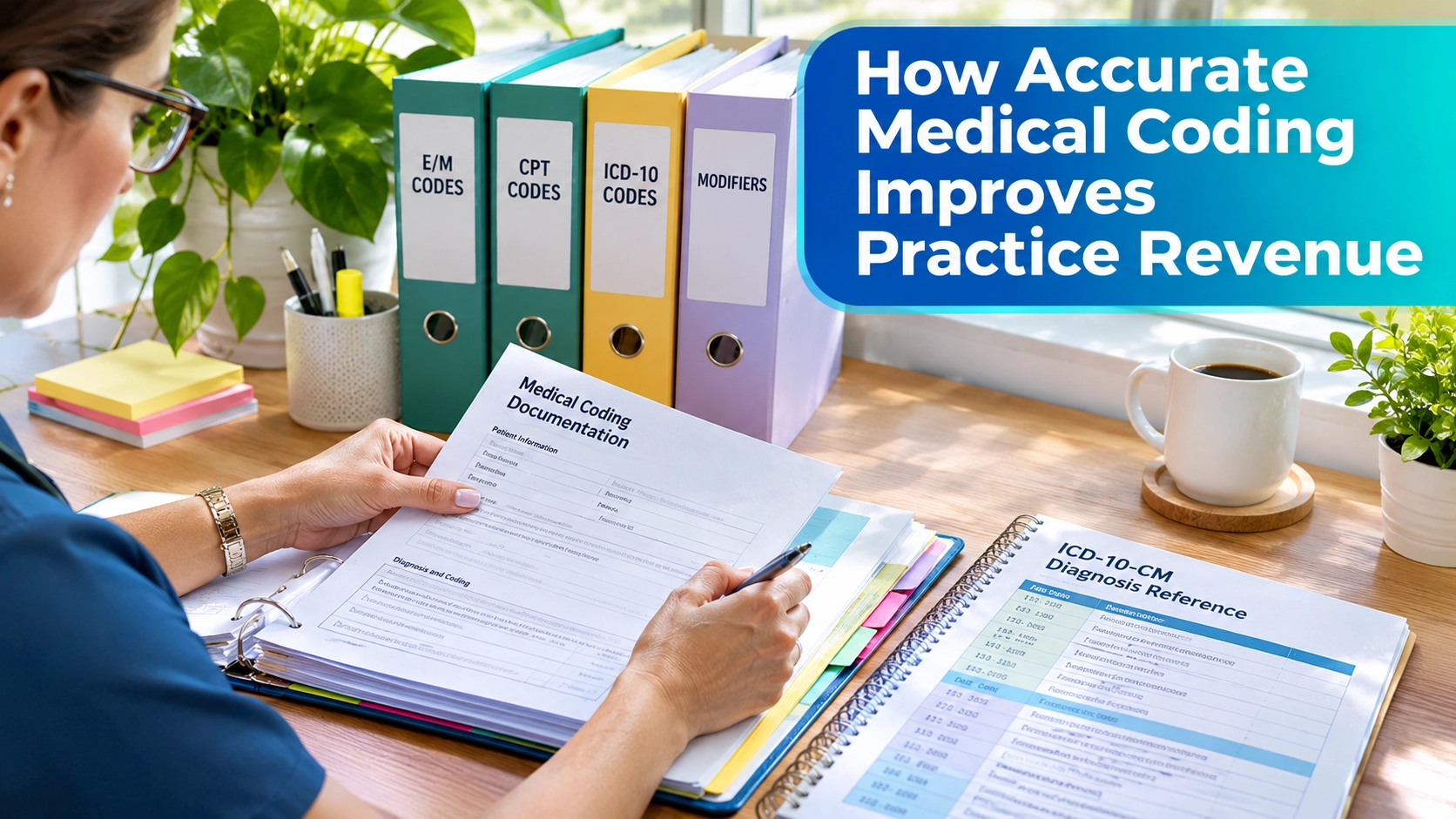
A practice can deliver excellent care and still lose revenue when what happened in the exam room is not accurately translated into codes. That gap between the record and the claim is where a surprising amount of revenue quietly disappears.
This article explains what coding involves, how accurate coding supports revenue, the errors that erode it, and the steps that strengthen coding accuracy, including the 2026 and 2027 code set updates.
Short answer
Accurate medical coding improves revenue by reducing coding-related denials, supporting correct reimbursement, preventing missed charges, raising first-pass claim quality and shortening payment delays. It does not guarantee payment or higher reimbursement; it makes sure the claim reflects the documented services, no more and no less. Keep documentation specific, load new code sets on time (FY 2027 ICD-10-CM from October 1, 2026; CPT 2027 from January 1, 2027), check NCCI edits, audit regularly and track coding-related denials.
Who this article is for
Physicians, practice managers and billing leads who want to understand how coding affects revenue and compliance.
Key takeaways
- ICD-10-CM explains why a service was provided; CPT and HCPCS describe what was done.
- Accurate coding supports appropriate reimbursement; it does not automatically increase it.
- Undercoding loses revenue; upcoding creates compliance risk. The goal is accuracy.
- Load FY 2027 ICD-10-CM codes for services from October 1, 2026 and CPT 2027 codes before January 1, 2027.
What is medical coding?
Medical coding converts the diagnoses, services and procedures documented in a visit into standardized codes that payers use to process claims.
Code set
What it describes
Example use
ICD-10-CM
What it describes: Diagnoses: the “why” behind the visit
Example use: The condition or symptom being treated
CPT
What it describes: Procedures and professional services: the “what”
Example use: Office visits, tests and surgical procedures
HCPCS Level II
What it describes: Supplies, drugs, equipment and services CPT does not fully cover
Example use: Injectable drugs, durable medical equipment, ambulance services
7 ways accurate coding improves practice revenue
Each one depends on documentation that supports the codes.
01
Fewer coding-related denials
Correct diagnosis-to-procedure links and modifiers prevent avoidable denials. See our denial prevention guide.
02
Accurate reimbursement
Claims reflect the services documented, which avoids both undercoding and overcoding.
03
Less revenue leakage
Every documented, billable service is captured on the claim.
04
Better first-pass claim quality
Fewer edits, rejections and requests for information.
05
Shorter payment delays
Fewer claims pulled aside for manual review or correction.
06
Stronger compliance
Codes follow current guidelines and are supported by the record.
07
A healthier revenue cycle
Clean coding supports every downstream step, from submission to A/R.
Coding rules and dates to know
Code sets and edits change on fixed schedules. Sources were checked on October 27, 2026.
Current code sets
Issued by: HHS / CMS and AMA · Reference: HIPAA code sets; FY 2027 ICD-10-CM; CPT 2027
Claims must use the code set versions valid on the date of service. FY 2027 ICD-10-CM codes apply to services from October 1, 2026, and the CPT 2027 code set takes effect January 1, 2027.
What to do: Load new code sets before their effective dates and update templates and charge masters.
Official source: CMS: ICD-10 · AMA: CPT 2027
NCCI edits
Issued by: CMS · Reference: National Correct Coding Initiative
NCCI procedure-to-procedure edits and medically unlikely edits stop payment for certain code pairs and unit counts.
What to do: Check NCCI edits before billing code pairs and units, and apply modifiers only when documentation supports them.
Official source: CMS MLN: NCCI
Returning overpayments
Issued by: CMS · Reference: 42 CFR 401.305
Medicare overpayments must be reported and returned within 60 days after they are identified. The deadline can be suspended for up to 180 days during a timely, good-faith investigation, and the lookback period is 6 years.
What to do: Review credit balances regularly and refund payer overpayments on time.
Official source: eCFR: 42 CFR 401.305
Legal requirement or best practice? Items labeled as federal law or Medicare rules are requirements for those they cover; rules for payers bind the payers. Everything else in this article is recommended practice. Commercial payers set their own rules in their contracts. OIG’s General Compliance Program Guidance recommends regular auditing of coding as part of a compliance program. This article is general education, not legal advice.
Common coding errors that cost revenue
Error
What happens
How to prevent it
Incorrect ICD-10-CM codes
What happens: Medical necessity questions or a mismatch with the procedure
How to prevent it: Code to the specificity documented
Incorrect CPT codes
What happens: Claim edits, denials or wrong payment
How to prevent it: Match the code to the service performed
HCPCS mistakes
What happens: Supplies, drugs or equipment billed incorrectly
How to prevent it: Check units and current HCPCS codes
Incorrect or missing modifiers
What happens: Services treated as duplicates or bundled
How to prevent it: Use modifiers only when the record supports them
Undercoding
What happens: Billable services left off or coded too low
How to prevent it: Review documentation for every billable service
Upcoding
What happens: Services coded higher than documented; a compliance risk
How to prevent it: Audit coding against documentation
Documentation mismatches
What happens: The record does not support the codes
How to prevent it: Give providers feedback on documentation gaps
Outdated code sets
What happens: Codes not valid for the date of service
How to prevent it: Load annual updates on time
An accidental coding mistake is not the same as fraud. But repeated errors, especially in one direction, are worth catching through regular audits before a payer does.
How to improve coding accuracy
Recommended practice.
01
Keep documentation complete and specific
Coding can only be as accurate as the record.
02
Load code updates on schedule
ICD-10-CM every October 1, CPT every January 1, HCPCS as CMS releases updates.
03
Audit a sample of claims regularly
Compare codes with documentation for each provider.
04
Track coding-related denials
Group them by code, provider and payer to find patterns.
05
Train providers and staff
Share audit findings and payer policy changes.
06
Use specialty-specific expertise
Procedure-heavy specialties need deeper modifier and payer knowledge.
Common mistakes and how to avoid them
Coding from memory
Code sets change every year; use current references.
Chasing higher payment
Codes must reflect the documentation, not the desired payment.
Ignoring undercoding
Missed services are lost revenue that nobody notices.
No feedback to providers
Documentation gaps repeat if no one explains them.
Auditing only after denials
Routine audits catch problems early.
Frequently asked questions
How does accurate medical coding affect practice revenue?
It reduces coding-related denials, supports correct reimbursement, captures all billable services and speeds up payment by improving first-pass claim quality.
Can medical coding errors cause claim denials?
Yes. Wrong diagnosis or procedure codes, missing or incorrect modifiers and documentation mismatches can all lead to denials.
What is the difference between ICD-10, CPT and HCPCS?
ICD-10-CM codes describe diagnoses, CPT codes describe procedures and professional services, and HCPCS Level II codes cover supplies, drugs, equipment and other services CPT does not fully capture.
When do new code sets take effect?
FY 2027 ICD-10-CM codes apply to services from October 1, 2026, and CPT 2027 codes take effect January 1, 2027.
How can a practice improve coding accuracy?
Keep documentation specific, load annual updates on time, audit regularly, track coding denials and train providers on documentation.
The bottom line
Accurate coding is the foundation of a clean claims process. Small, recurring coding problems rarely stay small, so keep documentation specific, code sets current and audits regular. Our medical coding team works to documentation-supported accuracy, alongside our medical billing and denial management services.
What to do next
Check whether your system has the FY 2027 ICD-10-CM codes loaded and the CPT 2027 update scheduled.
- Pull coding-related denials from the last quarter
- Audit a sample of claims for each provider
- Request a free billing analysis to see where coding may be affecting revenue
No obligation. No patient information needed.
Written by
Sam Asghar
CEO & Founder, 4Arcs Medical Billing
Originally published August 25, 2026 · Updated October 27, 2026 · Sources checked October 27, 2026
References
Disclaimer: This article is for general educational purposes and is not legal, coding or financial advice. Payer rules, code sets and regulations change, and their application depends on your practice. Confirm requirements with the official source, your payer contracts or a qualified professional.