
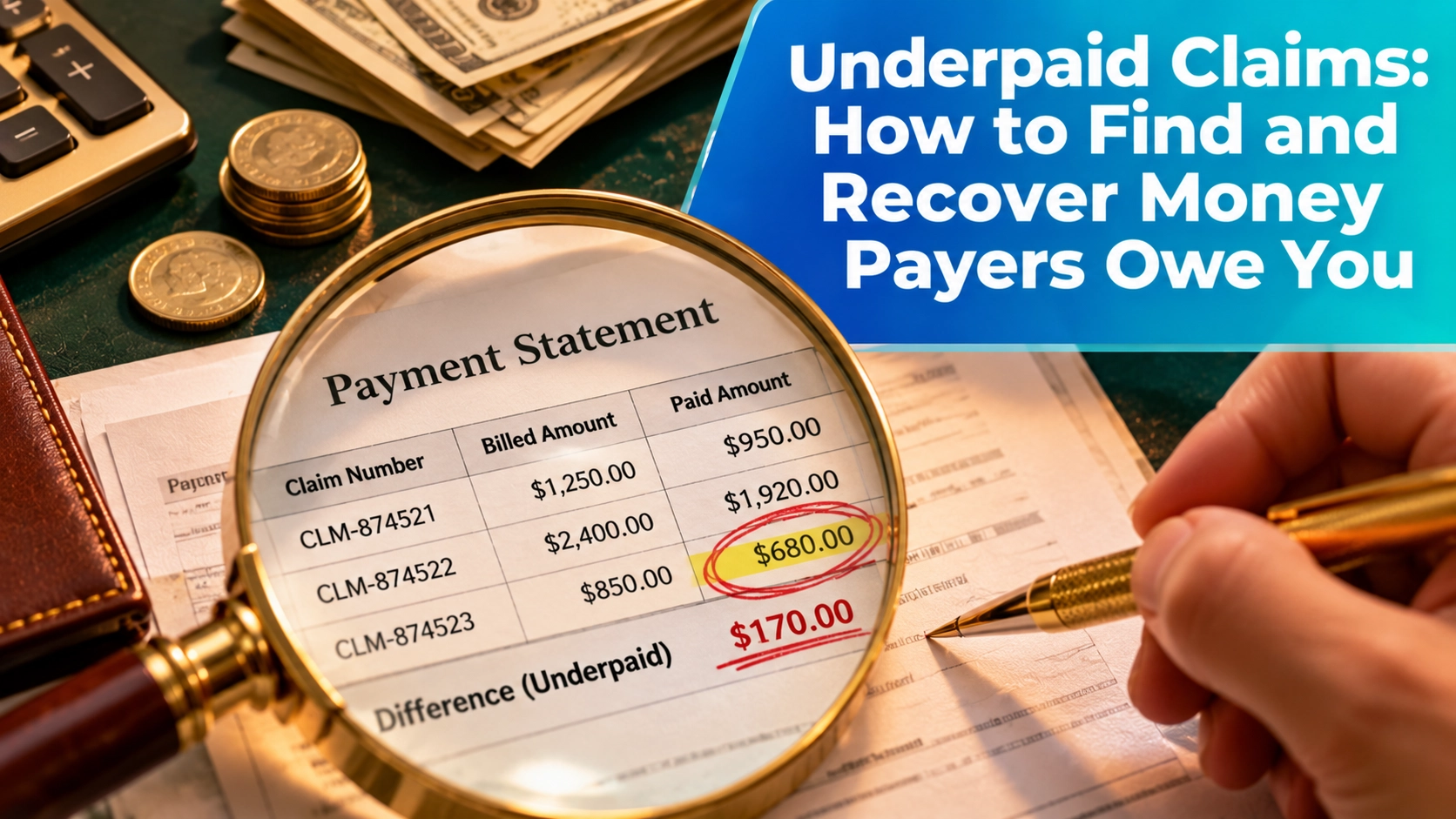
A denial is easy to notice: the claim comes back unpaid. An underpayment is quieter. The claim is paid, the remittance looks normal, and the money just falls a few dollars short of what your contract or fee schedule says it should be. Repeat that across hundreds of claims and it adds up.
This guide explains the most common types of underpayments, how to spot them on your remittances, and how to recover the money, including the Medicare and No Surprises Act rules that set your deadlines.
Short answer
An underpayment is a claim paid below the amount your contract or fee schedule allows. To find them, load your contracted rates into your billing system, compare the allowed amount on every ERA line with the expected amount, and group the differences by payer, code and reason. To recover them, ask the payer to reprocess, then use the appeal or dispute process in your contract. For Medicare, you can ask for a reopening within one year for any reason or file a redetermination within 120 days. Then fix the cause, such as an outdated fee schedule, so it does not happen again.
Who this article is for
Practice owners, billing managers and payment posters who want to make sure every paid claim was paid correctly.
Key takeaways
- An underpayment is a paid claim that falls short of your contract or fee schedule.
- You can only find underpayments if your contracted rates are loaded and compared with every payment.
- Medicare allows a reopening within 1 year for any reason, and clerical errors are processed as reopenings.
- Out-of-network disputes under the No Surprises Act have short business-day deadlines.
Six common types of underpayments
Code descriptions are from the X12 Claim Adjustment Reason Code list. Seeing these codes does not always mean an underpayment. It means the line is worth checking against your contract.
Outdated fee schedule
The payer applied last year’s rates, or did not load a contract amendment. Common in January, when new rates take effect.
Wrong reductions
Multiple procedure or modifier reductions applied when the contract or payer policy does not call for them. X12 code 59 marks multiple or concurrent procedure rules.
Incorrect bundling
A separately payable service is treated as included in another one. X12 code 97 marks services included in another service’s payment.
Wrong patient responsibility
Deductible, copay or coinsurance applied in the wrong amount, which shifts the payer’s share to the patient.
Wrong network or plan
The claim was priced as out-of-network or under the wrong product, such as a different plan’s fee schedule.
Discounts you did not agree to
A discount applied that is not in your contract. X12 code 131 marks a claim-specific negotiated discount.
How to spot underpayments on your remittances
Most underpayments hide inside a normal adjustment. X12 code 45 means “Charge exceeds fee schedule/maximum allowable or contracted/legislated fee arrangement.” That is the everyday contractual write-off, and it appears on almost every claim. The question is whether the allowed amount matches what you expected. For Medicare, you can check allowed amounts with the CMS Physician Fee Schedule search tool.
- Load every payer contract and fee schedule into your billing or contract management system
- For Medicare patients, compare allowed amounts with the Medicare Physician Fee Schedule for your locality
- Flag every ERA line where the allowed amount is below the expected amount
- Group the variances by payer, CPT or HCPCS code and adjustment reason
- Look for patterns: one code, one payer or one month usually explains most of the gap
A worked example
Hypothetical example for illustration only. The rates are made up and are not real payer or Medicare amounts.
Code
Service
Expected
Allowed
Short
Why
99214
Service: Office visit, established patient
Expected: $128.00
Allowed: $118.40
Short: $9.60
Why: Paid at last year’s rate
99213
Service: Office visit, established patient
Expected: $92.00
Allowed: $92.00
Short: $0.00
Why: Paid correctly
20610
Service: Joint injection, major joint
Expected: $68.00
Allowed: $34.00
Short: $34.00
Why: Reduction applied that the contract does not allow
93000
Service: Electrocardiogram
Expected: $17.50
Allowed: $0.00
Short: $17.50
Why: Bundled, though the contract pays it separately
Total
Service: One visit with all four services
Expected: $305.50
Allowed: $244.40
Short: $61.10
A $9.60 shortfall on one office visit is easy to miss. If the same outdated rate applies to 600 visits a quarter, it is $5,760 a quarter from one code and one payer. Because the patient’s coinsurance is calculated from the allowed amount, an underpayment can also make the patient’s share wrong.
How to recover underpayments
Recommended steps. Your contract and the payer’s provider manual set the exact process and deadlines.
01
Confirm the expected amount
Check the contract, any amendments, the fee schedule year and the payer’s payment policy for that code.
02
Group claims by pattern
Send one request for many claims with the same cause instead of one claim at a time.
03
Ask the payer to reprocess
Contact your provider representative with the claim list, the contract terms and the expected amounts.
04
Use the formal appeal or dispute process
If reprocessing is refused, follow the appeal steps and deadlines in your contract.
05
For Medicare, choose reopening or redetermination
Clerical errors go through a reopening; other disputes go through a redetermination within 120 days.
06
Fix the cause and keep checking
Update fee schedules every January, re-check after contract changes and keep monitoring. Our billing automation guide covers tools that compare payments automatically.
Rules and deadlines for underpayment recovery
Deadlines differ by payer type. These are the federal and Medicare rules most often involved. Sources were checked on October 23, 2026.
Reopenings within 1 year
Issued by: CMS · Reference: 42 CFR 405.980
A party may ask a Medicare contractor to reopen an initial determination within 1 year for any reason, or within 4 years for good cause. Clerical errors, including minor errors, omissions and computational mistakes, must be processed as reopenings.
What to do: Use a reopening for clear errors such as a wrong rate or a data entry mistake, and request it within the year.
Official source: eCFR: 42 CFR 405.980
Redetermination within 120 days
Issued by: CMS · Reference: 42 CFR 405.942
A Medicare redetermination must be requested within 120 days of receiving the initial determination, with receipt presumed 5 days after the notice date.
What to do: Use a redetermination when you disagree with how a claim was decided, not just a clerical error.
Official source: eCFR: 42 CFR 405.942
Out-of-network payment disputes
Issued by: HHS, DOL and Treasury · Reference: 45 CFR 149.510
For qualified out-of-network items and services, either party may start a 30-business-day open negotiation period beginning on the day the provider receives the initial payment or notice of denial. If no agreement is reached, the federal independent dispute resolution (IDR) process must be started within 4 business days after open negotiation ends.
What to do: Calendar these deadlines in business days the day an out-of-network payment arrives.
Official source: eCFR: 45 CFR 149.510 · CMS: About IDR
Adjustment reason codes
Issued by: X12 · Reference: Claim Adjustment Reason Codes
Payers explain adjustments with standard codes, such as 45 (charge exceeds fee schedule or contracted amount), 59 (multiple or concurrent procedure rules) and 97 (included in another service).
What to do: Report variances by adjustment code so you can see which payer rule is causing the gap.
Official source: X12 CARC list
Legal requirement or best practice? The Medicare and No Surprises Act timeframes are requirements. Commercial and Medicare Advantage underpayments are mostly governed by your contract and state law, which set their own payment and appeal deadlines. This article is general education, not legal advice; have significant contract disputes reviewed by a qualified professional.
Common mistakes and how to avoid them
Not loading contracted rates
Without expected amounts in your system, underpayments look like normal adjustments.
Missing the January rate change
New fee schedules take effect at the start of the year; check the first payments.
Appealing one claim at a time
Grouped requests for a single cause are faster and harder to ignore.
Forgetting the patient's share
When the allowed amount is corrected, the patient’s balance may change too.
Recovering without fixing
If the payer’s system is not updated, the same underpayment comes back next month.
Frequently asked questions
What is a payer underpayment?
A claim paid below the amount your contract, fee schedule or the applicable payment rules allow. Unlike a denial, the claim is paid, just not in full.
How do I know if a claim was underpaid?
Compare the allowed amount on the remittance with the expected amount from your contract or fee schedule. Any line where allowed is lower is a possible underpayment worth checking.
Can I fix a Medicare underpayment?
Yes. You can ask for a reopening within 1 year of the initial determination for any reason, and clerical errors are processed as reopenings. If you disagree with the decision itself, file a redetermination within 120 days.
What if an out-of-network claim was underpaid?
For qualified items and services under the No Surprises Act, you can start a 30-business-day open negotiation period from the day you receive the initial payment, then the federal IDR process within 4 business days if it fails.
How far back should we look for underpayments?
Start with the last 12 months, then focus on the payers and codes with the largest variances. Your contract and payer rules set how far back you can recover.
The bottom line
Underpayments are money you already earned. Finding them takes expected rates in your system and a regular comparison with every payment; recovering them takes grouped requests, the right appeal path and attention to deadlines. Fix the cause each time so the gap does not come back. Our medical billing and revenue cycle management teams compare payments with contracts as part of posting, and our guide to accounts receivable covers the follow-up side.
What to do next
Check your top payer’s payments against its contract before the January rate change.
- Confirm your contracted rates are loaded for your top five payers
- Compare last quarter's allowed amounts with expected amounts for your top 20 codes
- Request a free billing audit, including an underpayment review
No obligation. No patient information needed.
Written by
Sam Asghar
CEO & Founder, 4Arcs Medical Billing
Published October 28, 2026 · Sources checked October 23, 2026
References
- X12, Claim Adjustment Reason Codes
- CMS, Physician Fee Schedule quick reference search guide
- eCFR, 42 CFR 405.980, Reopening of initial determinations and redeterminations
- eCFR, 42 CFR 405.942, Time frame for filing a request for a redetermination
- eCFR, 45 CFR 149.510, Independent dispute resolution process
- CMS, About independent dispute resolution
Disclaimer: This article is for general educational purposes and is not legal or financial advice. The worked example uses hypothetical rates. Contract terms, payer policies and state laws vary; review your contracts and consult a qualified professional about significant payment disputes.


